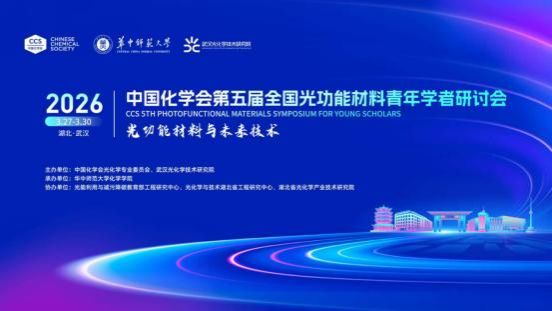
From March 28 to 30, the 5th National Symposium for Young Scholars on Optical Functional Materials organized by the Chemical Society of China was held in Wuhan. The symposium was co-hosted by the Photochemistry Committee of the Chemical Society of China and Wuhan Institute of Photochemical Technology, organized by the School of Chemistry, Central China Normal University, and co-organized by the Engineering Research Center of Light Energy Utilization and Carbon Reduction & Pollution Mitigation (Ministry of Education), Hubei Engineering Research Center of Photochemistry and Technology, and Hubei Institute of Photochemical Industry Technology. Top experts and young research elites in photochemistry across China gathered to explore cutting-edge developments and promote academic progress.
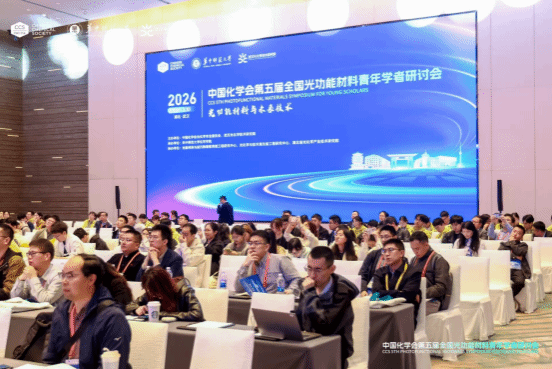
Vice President Liu Sannüya of CCNU noted in his address that the innovative development of photochemistry relies on the persistent efforts of generations of young scholars. He encouraged young researchers to blaze new trails and scale new heights in cutting-edge optical functional materials with pioneering spirit and down-to-earth research attitude.
On behalf of the organizing committee, Academician Wu Lizhu from the Technical Institute of Physics and Chemistry, Chinese Academy of Sciences, who served as Chair of the symposium, delivered an opening speech. She highly recognized the significance of the symposium for the growth of young scholars and urged young researchers to strengthen their ideals, shoulder their missions, break new ground in optical functional materials, and inject youthful impetus into the high-quality development of photochemistry in China.
Under the theme Optical Functional Materials and Future Technologies, the symposium covered frontier directions including luminescent materials, photovoltaic technology, photochemical theory, ultrafast spectroscopy, solar energy conversion, photochemical synthesis, fluorescent probes and bioimaging, with parallel sessions on inorganic catalysis and energy & environmental catalysis, organic photochemical synthesis, photobiology, supramolecular-polymer photochemistry, etc. More than 600 delegates and over 30 corporate exhibitors attended, with over 350 academic exchanges held.
The symposium provided a valuable platform for young scholars to showcase achievements, exchange ideas, and expand cooperation. It promoted in-depth collaboration among universities, research institutes, and industries, further consolidating the foundation for innovation in optical functional materials.







 Chinese