On December 10th, a research team led by professor Tong Jingjing from the School of Life Sciences of CCNU, in collaboration with the team led by Wang Zhihua from Fuwai Hospital, Chinese Academy of Medical Sciences, published their research findings online in the international journal Science Translational Medicine (also known as Sci Transl Med). The study is titled A hyperactive splice variant of STAT3 promotes colonic inflammation-associated tumorigenesis in mice.
The transformation of chronic inflammation into cancer is a major challenge in clinical medicine. Patients with inflammatory bowel disease (IBD) face a significantly higher risk of developing colorectal cancer (CRC) compared to the general population. As a core molecule in the JAK-STAT signaling pathway, STAT3 plays a double-edged sword role in this process: it maintains intestinal immune homeostasis under physiological conditions, but becomes abnormally activated upon chronic inflammatory stimulation, driving uncontrolled cellular carcinogenesis. However, therapeutic strategies targeting full-length STAT3 function are prone to inducing severe side effects, leading to repeated setbacks in clinical translation. This has emerged as a key bottleneck restricting the precise treatment of IBD and CRC through STAT3-targeted therapies.
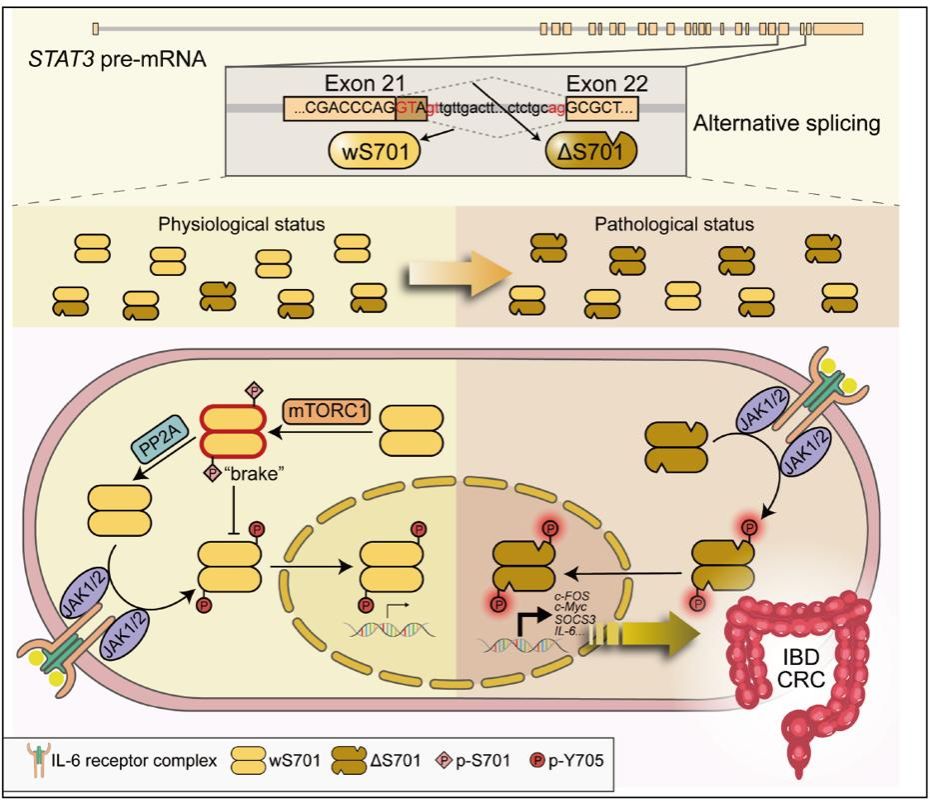
This study is the first to reveal the decisive impact of a single amino acid difference caused by alternative splicing on STAT3 function. Through an elaborate "feed-forward brake" mechanism, it has profoundly revised the understanding of colonic inflammation-tumor transformation. In the future, the development of subtype-specific diagnostic tools and targeted drugs for different STAT3 isoforms is expected to bring new therapeutic hope to patients with IBD and CRC.
This research was also supported by the National Natural Science Foundation of China, Hubei Provincial Talent Project, National Key Research and Development Program of China, and the Medical Science Innovation Fund of the Chinese Academy of Medical Sciences, among other projects.
Launched in 2009 and published by the American Association for the Advancement of Science (AAAS), Science Translational Medicine is one of the flagship journals of Science. It focuses on promoting the integration of basic medical research and clinical applications. As a top-tier journal in the field of translational medicine, it boasts a 5-year impact factor of 16.9 (JCR Q1), ranks in the Top 1 of Medical Sciences (CAS 2025 Classification) and holds the second position globally in the Medical Research & Experimental category. The journal publishes approximately 300 articles annually, covering cardiovascular diseases, tumor immunology, and particularly emphasizing innovation in interdisciplinary research.








 Chinese