On April 16, 2026, the Forum on the Innovative Development of Smart University Libraries in the 15th Five-Year Plan Period opened in Wuhan. Themed “Data-Driven Intelligence, New Knowledge Empowerment”, the event was organized by the Hubei Provincial Steering Committee for Academic Library and Information Work and hosted by the Library of Central China Normal University (CCNU). More than 1,300 library directors and professional staff from 618 universities nationwide gathered to explore pathways for smart library development in the new five-year cycle.
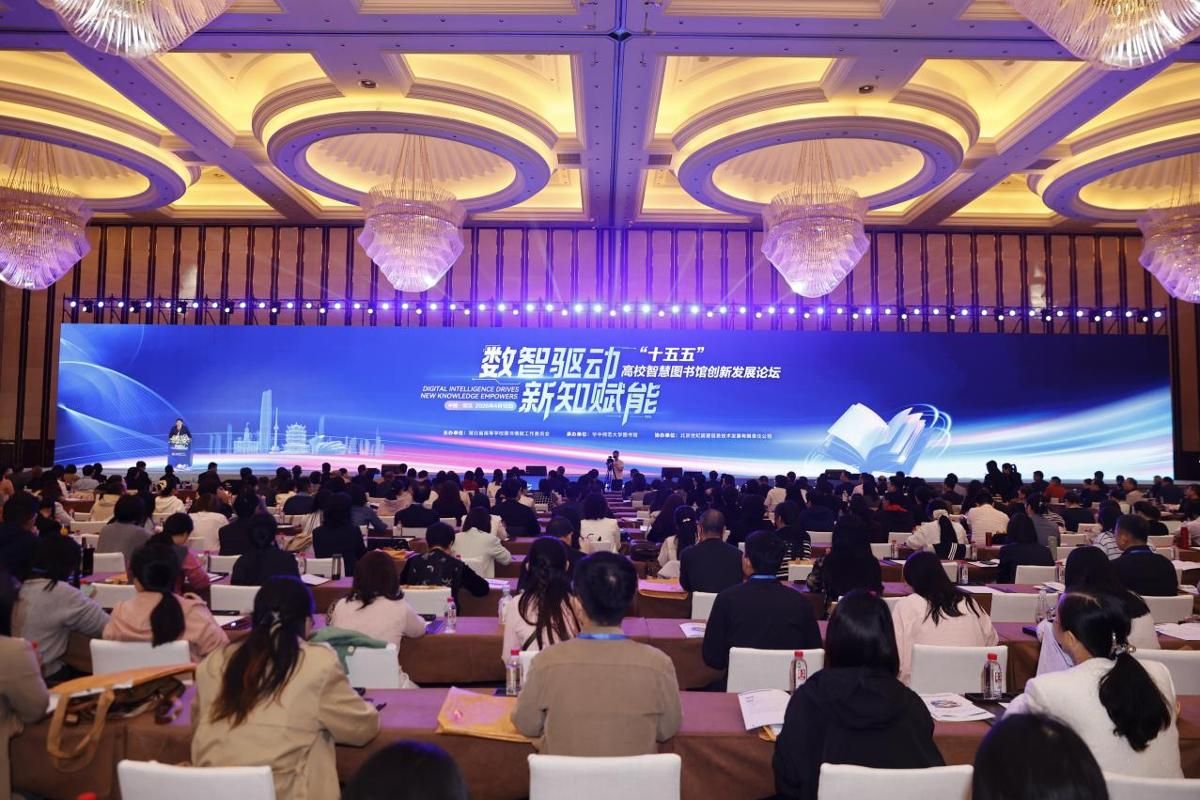
Xia Lixin, Secretary of the CCNU Party Committee, noted in his opening address that new productive forces represented by artificial intelligence and big data are reshaping knowledge production, dissemination and services, bringing huge momentum to the smart transformation of university libraries. He emphasized that CCNU is advancing education digitalization to boost its Double First-Class initiative, positioning the library as a second classroom for moral education, a smart engine for educational innovation, and a knowledge hub for regional development. Rao Guian, Researcher of the Higher Education Division of the Hubei Provincial Department of Education, mentioned that the forum provides targeted guidance for Hubei’s academic library development and offers valuable references for smart library construction nationwide. He expected further collaboration to advance smart libraries and support the building of a strong country in education, science and technology, and culture.
At the forum, achievements of the National Key R&D Program, Key Technologies and Application Demonstration for Smart Library System Construction were officially released. Wu Dan, Vice President of CCNU, interpreted the Global Smart Library Development White Paper covering development background, trends, indexes, international comparisons and future prospects. CCNU also officially put its Future Learning Center into operation.
In keynote sessions, renowned scholars and library leaders from universities including Wuhan University, Sun Yat-sen University, Nankai University, Renmin University of China, Shanghai Jiao Tong University, Beijing Normal University, and University of Science and Technology of China shared insights on value reshaping, future transformation, learning center construction, and librarian role evolution in the digital-intelligent era. The concepts, key technological achievements, and practical cases discussed at the forum will serve as important references for promoting the digital transformation of libraries and empowering high-quality development of higher education.





 Chinese