Recently, the research team led by Professor Niu Chenhui from the School of Physical Science and Technology of CCNU, in collaboration with Tsinghua University, Yunnan University, the National Astronomical Observatories of the Chinese Academy of Sciences and other institutions, published an important research paper entitled A Persistently Active Fast Radio Burst Source Embedded in an Expanding Supernova Remnant in Science Bulletin, a top international academic journal. The paper was also selected as the cover article for the journal’s first issue of 2026. Professor Niu Chenhui is the first author and corresponding author of the paper.
Science Bulletin is an internationally recognized high-level comprehensive scientific journal with the latest impact factor of 21.1, boasting important academic influence in the field of basic science. After the publication of this research achievement, it has received attention and coverage from many mainstream media outlets including Science and Technology Daily, Xinhua News Agency (English Edition) and China National Radio.
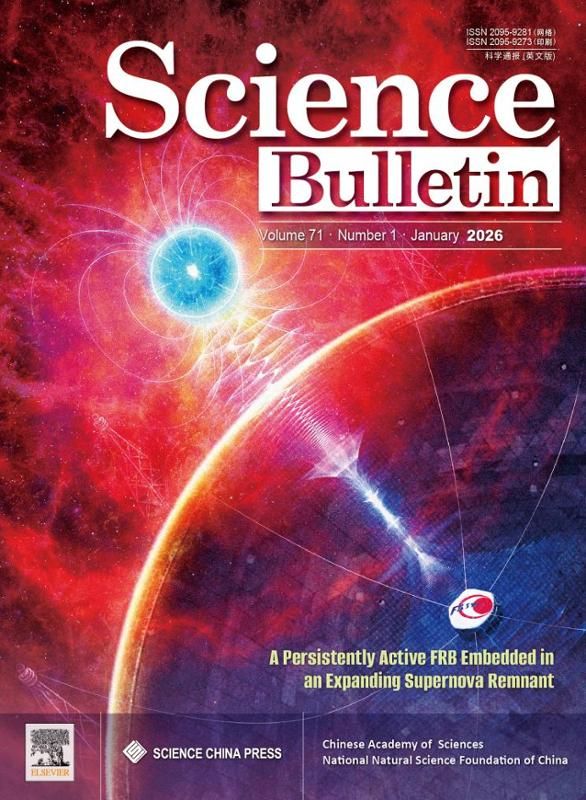
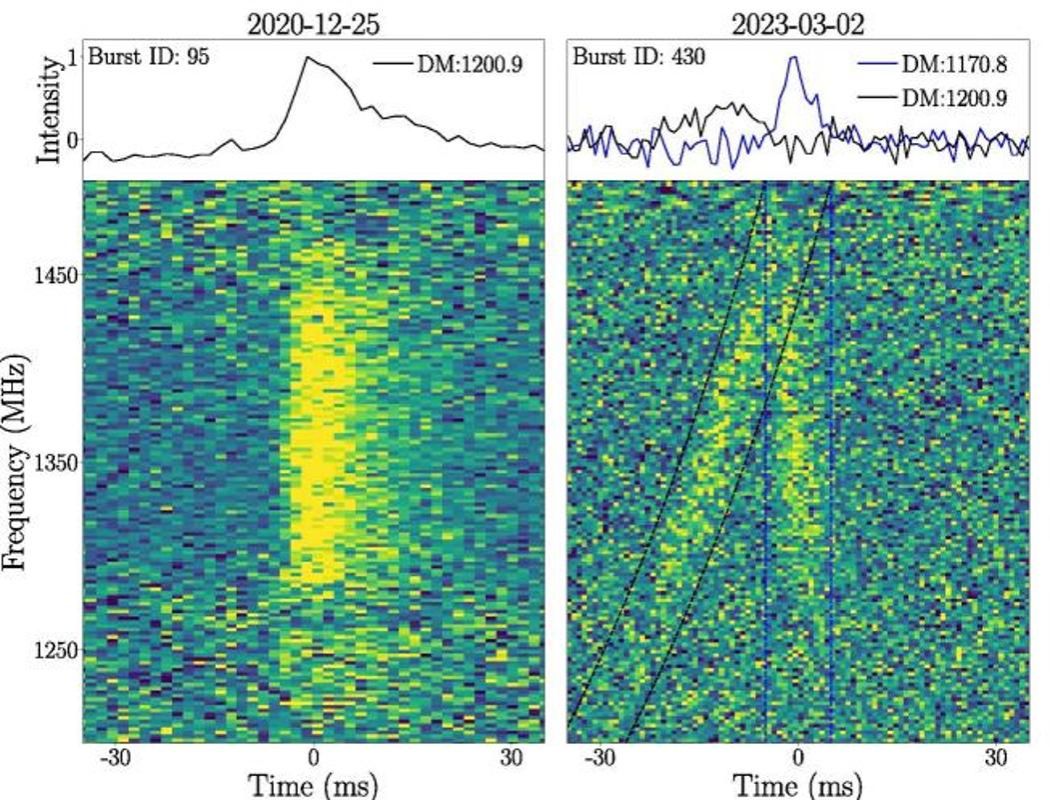
Fast Radio Bursts (FRBs) are millisecond-scale intense radio burst phenomena originating from the depths of the universe, and remain one of the most challenging frontier issues in modern astronomy. Due to the fact that most FRB events are detected only once or show discontinuous activity, their origin and cosmic environment have long been unclear. FRB 20190520B is the world's first persistently active FRB source discovered by the Commensal Radio Astronomy Fast Transient Survey (CRAFTS), a priority major project of the Five-hundred-meter Aperture Spherical Telescope (FAST, also known as China's Sky Eye). Following its discovery, Professor Niu Chenhui led a four-year systematic follow-up observation, obtaining rare long-term evolutionary data of the source. The results show that the Dispersion Measure (DM) of this source has been significantly and continuously decreasing, with an annual variation rate of 12 pc cm³, indicating that the radio signals are passing through a rapidly expanding dense plasma environment.
Professor Liam Connor from the Department of Astronomy at Harvard University, a renowned scholar in the field of FRB research, commented that Before fast radio bursts were precisely localized to their host galaxies, we hypothesized that they might be born from young neutron stars still enveloped in supernova remnants. This study provides the most compelling observational evidence to date, clearly demonstrating that at least one class of repeating fast radio bursts indeed originates from the death site of their massive progenitor stars. This discovery represents an exciting breakthrough in uncovering the true origin of fast radio bursts.
In recent years, with the support of CCNU and School of Physical Science and Technology, the astrophysics team led by Professor Zheng Xiaoping has continuously strengthened the introduction and cultivation of talents. A number of young scholars have published important research achievements as first authors or corresponding authors in top international journals such as Nature Astronomy and Science Bulletin.








 Chinese