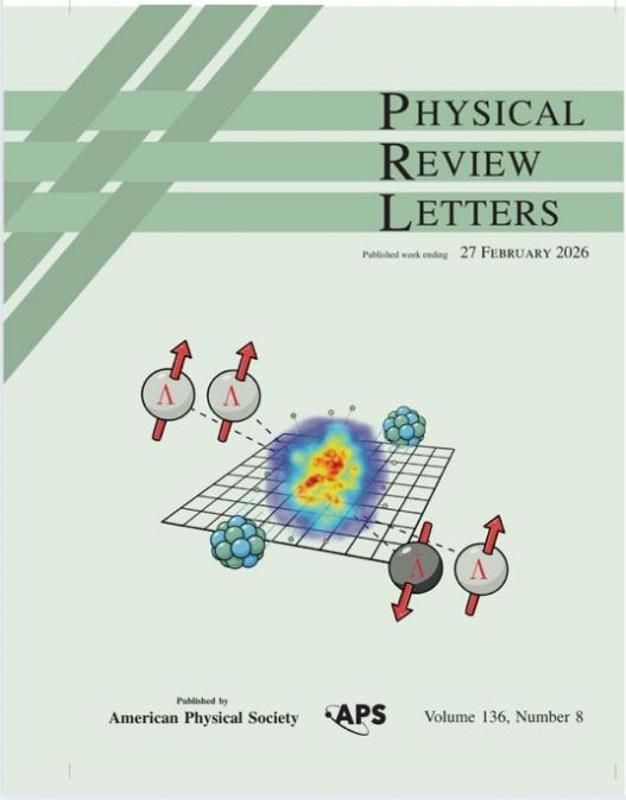
In high-energy heavy-ion collision experiments, matter is heated to extremely high temperatures, forming a novel state of matter dominated by the strong interaction—the quark-gluon plasma (QGP). Probing the spatiotemporal structure of the strong interaction field inside the QGP has long been a major challenge in the field of high-energy nuclear physics. Recentlt a research team led by Professor Wang Xinnian from CCNU has now made a pivotal breakthrough to address this issue, with their findings published as a cover story in the prestigious Physical Review Letters.
The interdisciplinary team consists of Postdoctoral Fellow Sheng Xinli from the University of Florence (formerly a postdoc at CCNU), Postdoctoral Fellow Wu Xiangyu from McGill University (a PhD graduate of CCNU), Professor Dirk Rischke from the University of Frankfurt, and Professor Wang Xinnian from CCNU. They proposed an innovative observable—net spin correlation of hyperons, which can effectively eliminate hydrodynamic background effects and for the first time provide a clear experimental approach for quantitatively measuring the strength of strong field fluctuations inside the QGP.
The research builds on a pioneering prediction made by Professor Wang and Professor Liang from Shandong University in 2004. They posited that part of the enormous orbital angular momentum from non-central heavy-ion collisions is transferred to the QGP, endowing it with a strong global vorticity. Through spin-orbit coupling, quarks in the QGP undergo global spin polarization along the direction of the system’s angular momentum. This "polarization induced by fluid vorticity" phenomenon was experimentally verified by the Solenoidal Tracker at RHIC (STAR) Collaboration in 2017 and 2023 via observations of hyperon polarization and vector meson spin alignment.
Despite the success of the macroscopic rotation mechanism, experimental measurements of vector meson spin alignment (dependent on spin correlations between constituent quarks and antiquarks) show a signal amplitude far exceeding theoretical predictions from classical fluid vorticity or electromagnetic field mechanisms. To explain this anomaly, members of the team previously hypothesized that in addition to macroscopic fluid vorticity, the strong interaction field inside the QGP exhibits intense short-range microscopic fluctuations. These fluctuations induce additional spin correlations between spatially adjacent quarks, leading to the observed vector meson spin alignment. However, the dominance of this mechanism has remained controversial in both theory and experiment due to the overlap of strong field fluctuations and hydrodynamic effects.
To rigorously test the strong field fluctuation mechanism, the team turned to the hyperon system. Given the unified physical origin of hyperon spin polarization and vector meson spin alignment at the quark level, spin correlations dominated by strong field fluctuations should also exist between hyperons.








 Chinese