Clarivate Analytics has recently released its latest Journal Citation Reports (JCR). Advanced Agrochem, China’s first international English language journal in agricultural chemistry, supervised by the Ministry of Education and hosted by Central China Normal University (CCNU), has obtained its inaugural Impact Factor of 9.2. It is placed in JCR Q1 Quartile and ranks among the top 10% in its subject category. Only four years after its launch, the journal has joined the ranks of world�class scholarly journals with remarkable performance.
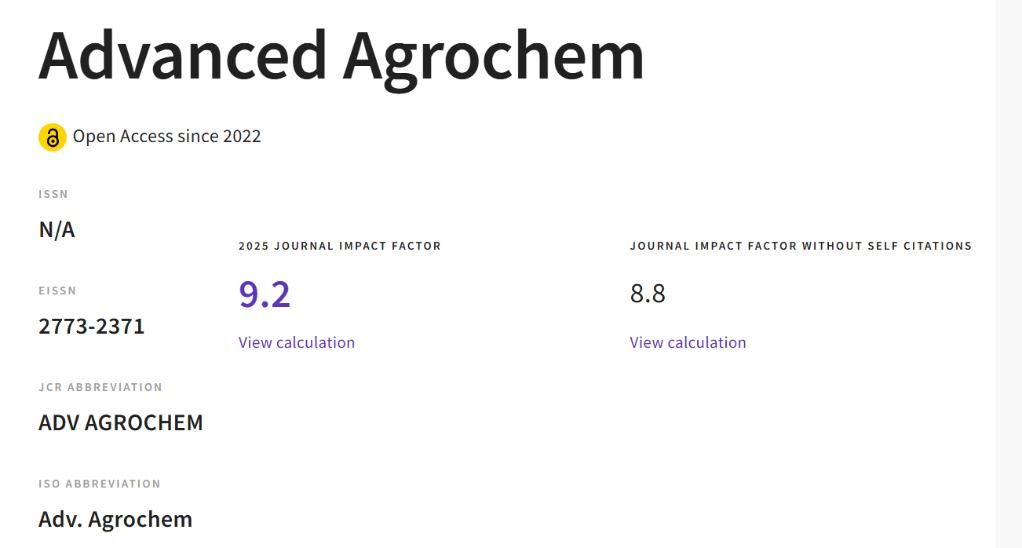
Advanced Agrochem has been indexed by nine major domestic and international authoritative databases including ESCI, Scopus, DOAJ, CAS, CSCD and BIOSIS Previews. It was selected for the New Journal Project (Phase II) of China’s Excellent Action Plan for Scientific and Technological Journals in 2024. In 2025, it was included in the World Journal Clout Index (WJCI) Report and secured the No. 1 position in the agronomy discipline. Its academic influence has won wide recognition both at home and abroad.
The journal focuses on cutting edge research areas such as agricultural chemistry, chemical biology, agricultural biotechnology, artificial intelligence for agriculture, smart plant protection and food safety. In 2025, it published 45 papers, of which 62% were interdisciplinary studies covering nanopesticides, gene editing and AI-driven plant protection. The 2026 Best Paper Awards have highlighted a series of high-level outputs, including nucleic-acid-based pesticides, scenario oriented molecular design of nanopesticides, the PDAI platform for AI empowered pesticide molecular design, and dual responsive nanocontrolled release systems. These achievements span frontier disciplines ranging from new pesticide innovation and nanotechnology to biological control and AI-aided design.
Moving forward, the journal will continue to operate as an open access publication. Priority submission themes include molecular design and action mechanisms of green pesticides, agricultural nanotechnology and intelligent drug delivery systems, agricultural analytical chemistry and food safety, applications of gene editing and synthetic biology technologies, agrochemical innovations powered by AI and big data, plant growth regulators, and integrated pest management. Particular encouragement is given to innovative agricultural research that applies emerging biotechnologies such as nanotechnology, gene editing, chemical probes, proteomics and in vivo imaging. The journal aims to build a high level exchange platform for global agrochemistry researchers and contribute to green agricultural development and food security worldwide.








 Chinese